
Evaluation of Concrete Durability for a Historic Rail Bridge Abutment
Summary
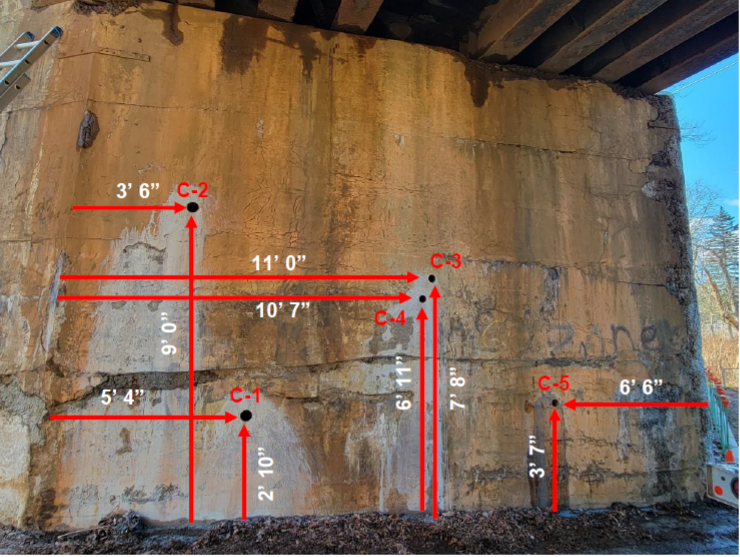
80 year old concrete abutment showing locations of concrete cores.
NDT Corporation performed a condition evaluation of a concrete bridge abutment supporting the Massachusetts Bay Transportation Authority (MBTA) rail line over Cove Road in Haverhill, MA. Constructed more than 80 years ago, the cast-in-place concrete south abutment had no available construction records or as-built documentation, leaving the owner with limited information regarding its reinforcement, material properties, and long-term durability.
NDT Corporation was retained to determine the presence of reinforcing steel and evaluate the condition of the concrete through non-destructive testing and laboratory analysis, providing the data required to support rehabilitation planning
Scope
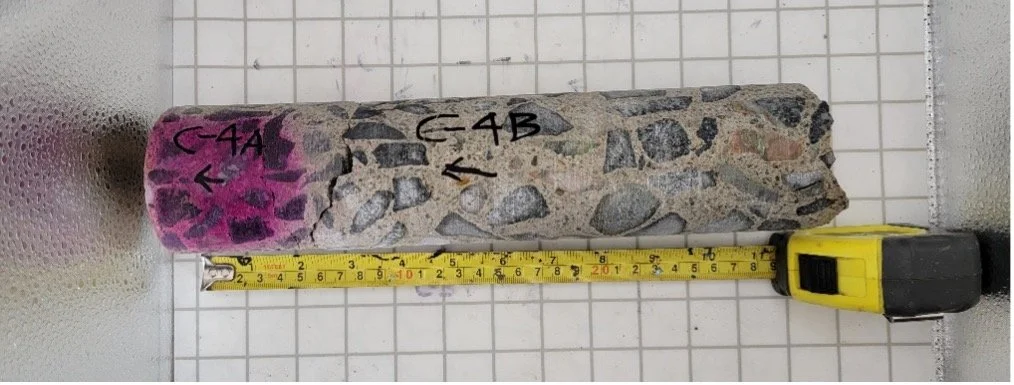
Typical concrete sample after carbonation testing (present from surface to a depth of 3 inches.
Reinforcement Mapping: Employed Ground Penetrating Radar (GPR) to determine the presence, spacing, and cover depth of reinforcing steel within the concrete south abutment.
Material Correlation: Recovered five concrete core samples for laboratory evaluation, including compressive strength testing in accordance with ASTM C42, petrographic analysis in accordance with ASTM C856, and carbonation testing to assess the condition and durability of the concrete.
Condition Assessment: Evaluated the internal construction of the south abutment to compensate for the absence of original design drawings and as-built documentation.
Solution
Reinforcement Findings: GPR data definitively indicated that the south abutment contained no reinforcing steel, eliminating the need for corrosion potential testing and chloride ion sampling.
Strength Correlation: Laboratory testing determined an average concrete compressive strength of approximately 3,030 psi, providing quantitative material property data for the structural evaluation.
Forensic Material Insight: Petrographic analysis identified both macro and micro cracking due to extensive freeze-thaw cycles and active alkali silica reaction (ASR). These were noted as the primary deterioration mechanisms affecting the concrete.
Preservation Guidance: NDT Corporation provided the quantitative data required for the engineering evaluation, enabling the owner to develop an informed rehabilitation strategy for the historic bridge structure.
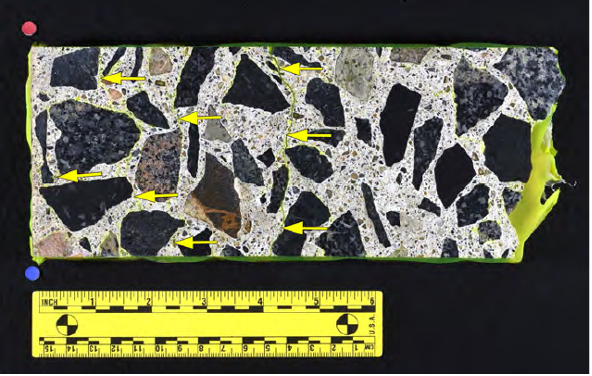
Cracking results of concrete sample cut with a polished surface. Plane light.
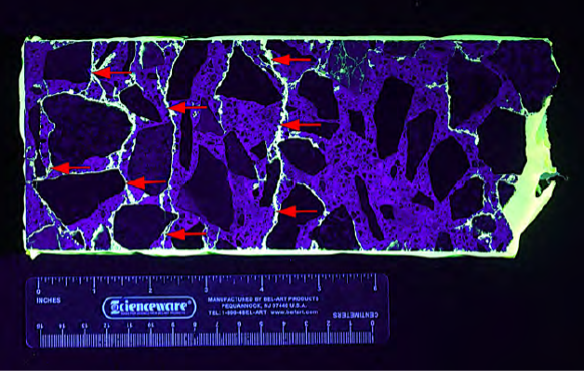
Cracking results of concrete sample cut with a polished surface. Fluorescent light