

Pre-stressed & Post-Tension Concrete Inspection
Non-destructive testing (NDT) provides critical field data to help identify visible and hidden conditions within reinforced concrete structures, supporting condition assessments without invasive investigation.
NDT Corporation provides non-destructive testing services to evaluate concrete durability, locate internal defects, and detect corrosion-related deterioration. Our skilled technicians work with engineers and asset owners to identify the appropriate testing technologies for each project and deliver accurate, quantitative datasets that support structural assessments, repair design, rehabilitation planning, and long-term asset management.

METHODS
Grout Void and Defect Identification (Bonded PT)
Inspecting Internal Post-Tensioning
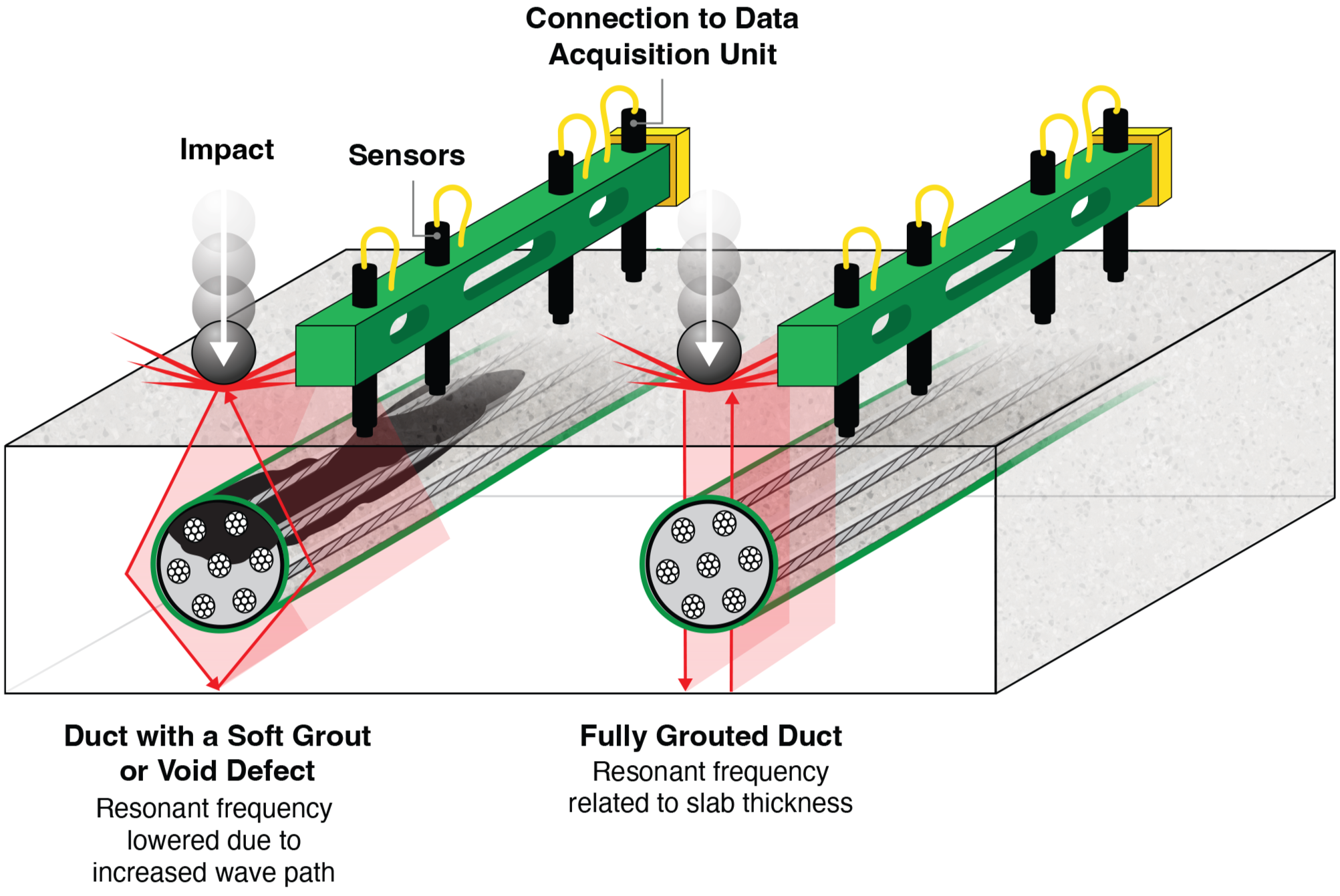
Impact Echo (IE) testing is used to examine internal post-tensioning tendons and identify grout defections. Conditions such as voids or soft grout within the tendon duct can reduce corrosion protection and affect the long-term durability of the prestressing system.
During testing, stress waves are placed on the concrete near the post-tensioning duct. The resulting wave response is recorded and analyzed to determine the resonant frequency of the system. When voids or soft grout are present within the duct, the wave travel path and material response are altered, resulting in a measurable reduction in resonant frequency.
By collecting IE measurements along the length of a tendon, variations in resonant frequency can be used to identify locations where grout defects may exist.
Inspecting External Post-Tensioning
Pulse Velocity (PV) testing is used to evaluate grout conditions in external post-tensioning tendons. The method involves introducing a stress wave into the tendon duct and measuring the time required for the wave to travel between sensors.
During testing, a wave source and receiver are positioned on opposite sides of the tendon duct to measure wave transmission through the system. Changes in the recorded pulse velocity signal may indicate grout conditions such as voids, water infiltration, or soft grout within the duct.
Measurements collected along the tendon length can be used to identify locations where grout characteristics differ and where further investigation may be required.

IE/PV testing of internal PT tendons on a bridge.
Unbonded Post-Tensioned (PT) Evaluation
The structural stability of unbonded PT structures relies on the high-tensile strength of embedded steel strands and the security of their end anchorages. Because these tendons are not bonded to the concrete matrix, they are susceptible to sudden failure if corrosion or mechanical damage occurs at any point along the strand.
NDT Corporation utilizes a specialized suite of non-destructive and locally invasive techniques to mitigate these risks, providing engineers and owners with the data necessary to extend the service life of their infrastructure.
Our Specialized Evaluation Process
Precision Mapping: The first step in any PT evaluation is the non-destructive documentation of the system's layout.
High-Frequency Ground Penetrating Radar (GPR): We map the exact horizontal and vertical profiles of the PT tendons and adjacent conventional reinforcement. This minimizes the risk that any subsequent testing, core drilling, or structural modifications can cause accidental tendon strikes.
Comprehensive Visual Inspection: Before performing invasive testing, NDT conducts a forensic walkthrough to identify external indicators of internal distress.
Anchorage & Slab Assessment: We inspect exposed anchorages for signs of "pushed out" wedges, grease leakage, or heavy oxidation.
Surface Manifestations: Technicians document cracks following tendon profiles, moisture staining at construction joints, and distress at expansion joints—all of which serve as critical indicators for targeted internal investigation.
Physical Integrity & Tension Verification: When visual or quantitative proof of tendon health is required, NDT employs locally invasive methods to "see inside" the system.
Sheathing Inspection: Technicians create localized "windows" to inspect the protective plastic sheathing and the presence and condition of the internal corrosion-inhibiting grease.
Strand Assessment: We examine the steel strands for signs of oxidation, pitting, or wire breaks.
Tension Testing: Tendon stress is qualitatively assessed via screwdriver penetration or precisely quantified using calibrated lift-off testing and lateral load testing frames.
Advanced Corrosion Diagnostics: Environmental factors are the primary threat to PT longevity. NDT Corporation uses industry-leading technology to detect both the risk and the actual rate of deterioration.
Post-tech® Corrosion Evaluation: For encapsulated systems, we utilize specialized internal moisture testing to identify the risk of oxidation before physical damage occurs.
Corrosion Potential Mapping: We utilize half-cell potential testing to identify active corrosion zones in paper-wrapped button-head systems and conventional reinforcing.
Quantitative Corrosion Rate Testing: For conventional reinforcement we utilize CorroMap technology to measure the actual corrosion rate (current density), providing data for cathodic protection design and service-life modeling.
By combining these diagnostic tools, NDT Corporation provides a comprehensive risk profile used to develop repair and protection strategies that extend the life of unbonded post-tensioned infrastructure.
Borescope Inspection
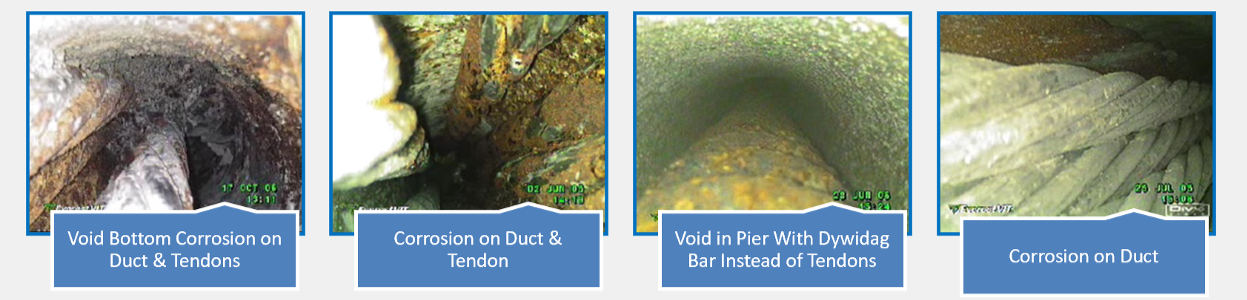
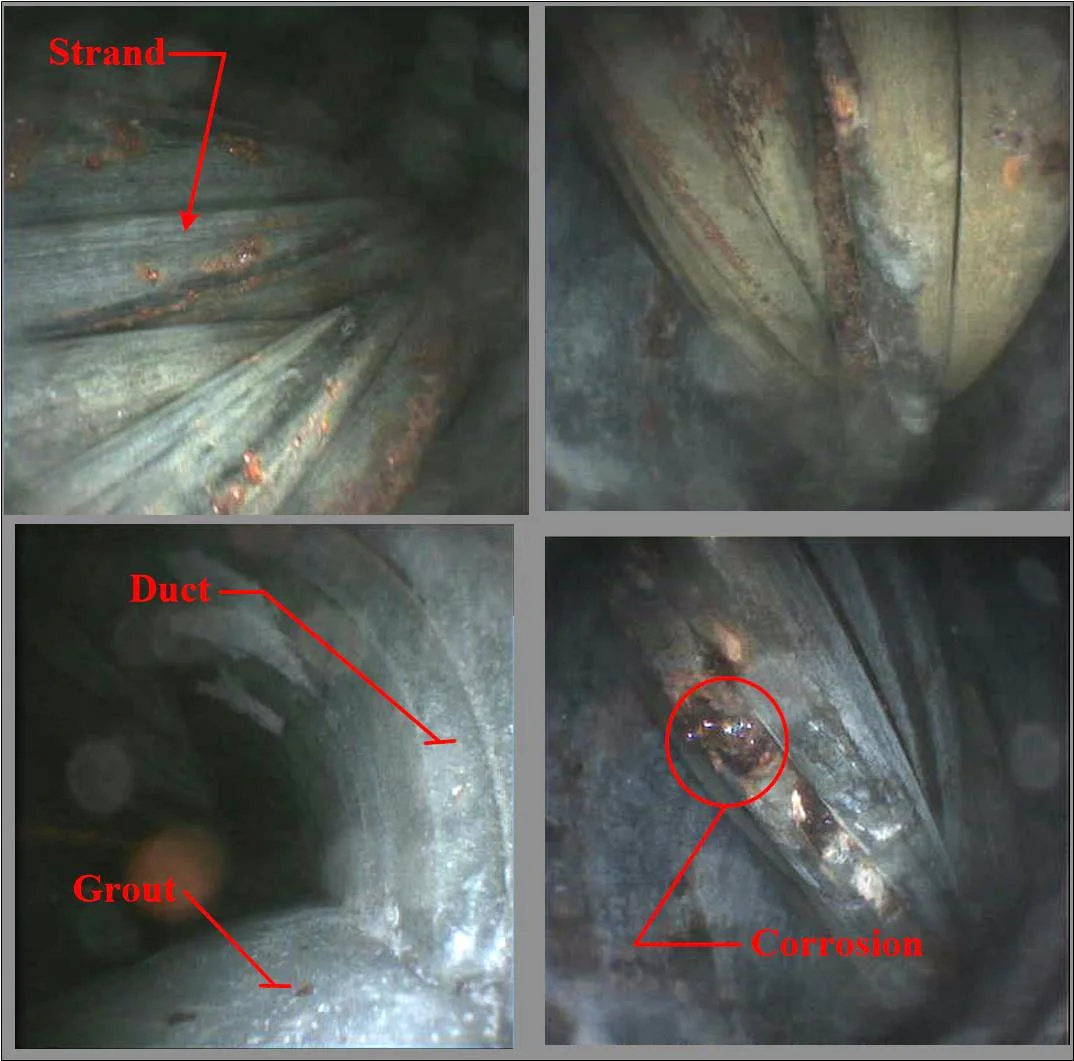
Once potential post-tensioning (PT) grout anomalies such as voids or soft grout have been identified through prior testing, access points can be created in the tendon duct to allow for borescope inspection. This typically involves drilling a small opening to insert the borescope and visually observe internal conditions.
Borescope inspection provides direct visual documentation of grout conditions within the duct while minimizing physical disturbance to the PT system.
In cases where grout conditions warrant further examination, larger access openings may be created to obtain grout samples for laboratory analysis, based on project requirements.
Pre-stressed Concrete Inspection Methods
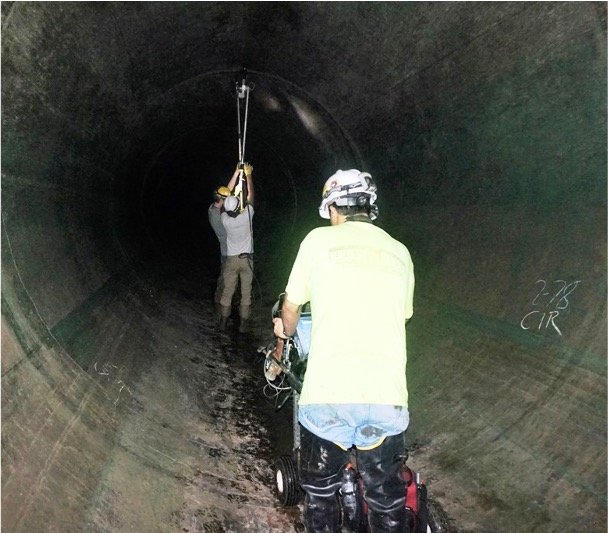
Inspection of prestressed concrete infrastructure is intended to assess structural integrity, prestress condition, material quality, and long‑term durability risks. The process typically begins with visual inspection to identify surface cracks, spalling, rust staining, efflorescence, and deformation, which often provide early indicators of prestress loss or tendon distress. For prestressed systems, visual inspection alone is insufficient, so it is routinely supplemented with non‑destructive testing (NDT) to evaluate internal conditions without damaging critical load‑carrying components that can be brittle after prestressed.
Common NDT methods include pulse velocity (PV) for detecting internal cracking, voids, and general concrete quality/strength; and impact echo (IE) testing for identifying delaminations, thickness changes, and poorly grouted post‑tensioning ducts. Ground penetrating radar (GPR) is widely used to locate prestressing tendons, ducts, and reinforcement, making it essential for beams, bridge decks, slabs, and pipes prior to drilling or coring. Infrared thermography helps detect near‑surface delaminations and moisture intrusion in slabs and decks, while half‑cell potential and electrical resistivity testing are used to assess corrosion likelihood in prestressed members.
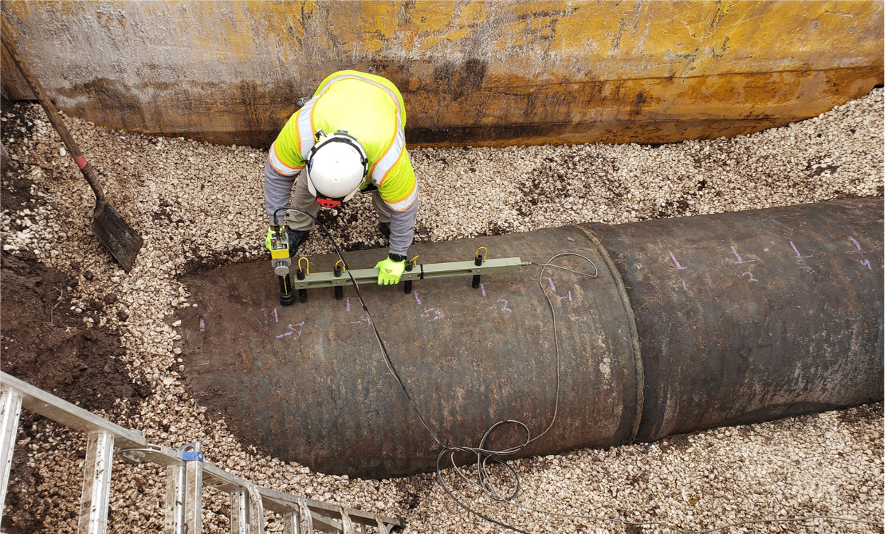
For 30 years NDT Corporation has been applying IE/PV testing to assessing prestressed concrete cylinder pipe (PCCP) and bar wrapped pipe (BWP), where it can assess where broken prestressing wires may exist and the pipe section is no longer in compression.
Experience You Can Rely On
Founded in 1994, NDT has built a reputation for delivering reliable data, practical insight, and responsive service on technically complex projects. Our team combines decades of field experience with advanced testing technologies to produce results that are clear, defensible, and actionable for engineers and owners.