
River Valley Floor Profiling for High-Yield Well Siting
Summary
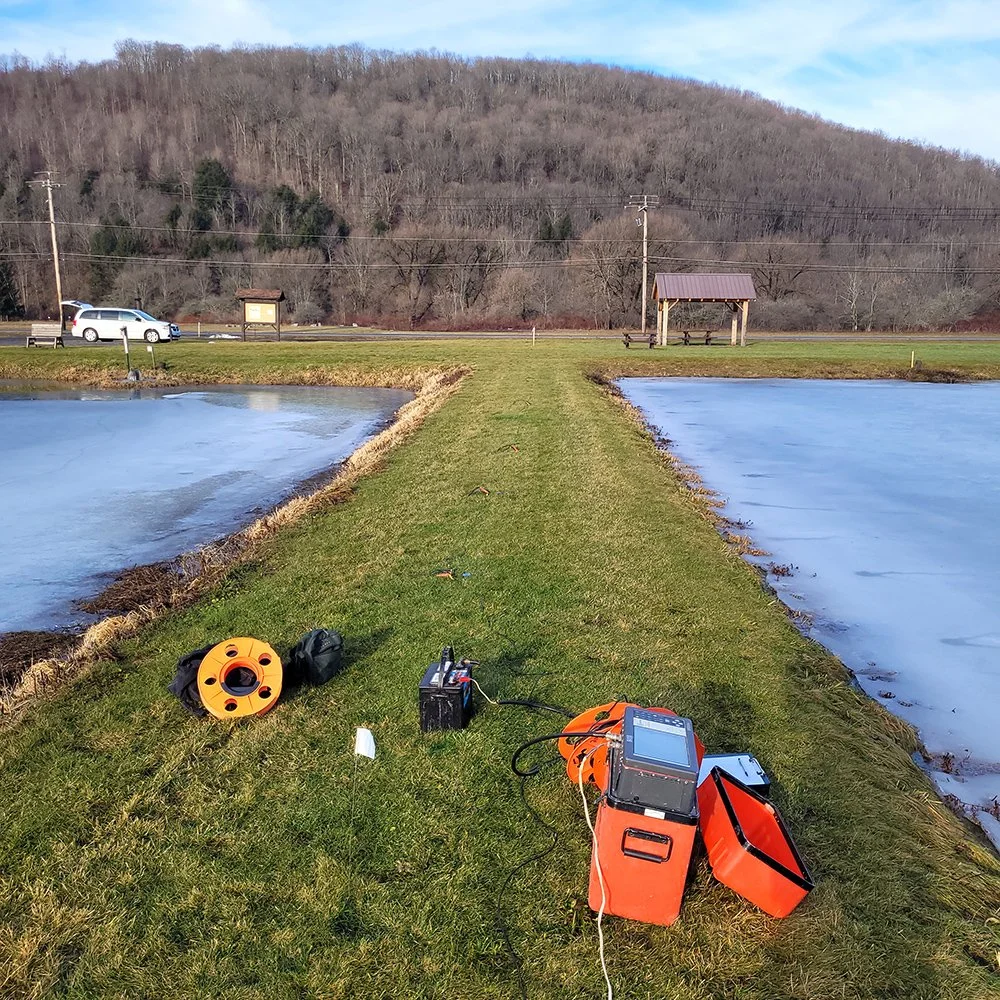
A fish hatchery facility faced a critical operational challenge when a newly installed pumping well failed to provide sufficient water flow rates.
To resolve the shortage, the owner and contractor sought to identify an optimal location for a secondary well by pinpointing deep deposits of coarse gravel and localized rock within the geologic river valley floor.
NDT Corporation was retained to conduct a specialized geophysical survey to map the bedrock topography and identify the subsurface features most likely to serve as high-yield aquifers.
Scope
Seismic Refraction Survey: Profiled the river valley floor by collecting refracted energy wave data along two primary transects using overlapping 400-foot-long seismic lines.
High-Resolution Data Acquisition: Utilized a 24-channel seismograph with geophones spaced at 10-foot intervals to ensure precise arrival-time recordings.
Subsurface Depth Mapping: Employed a "betsy" seisgun energy source to obtain "top-of-rock" data to depths of approximately 150 feet below the surface.
Geologic Interpretation: Analyzed wave arrival times to differentiate between glacial till deposits and the underlying bedrock surface.
Solution
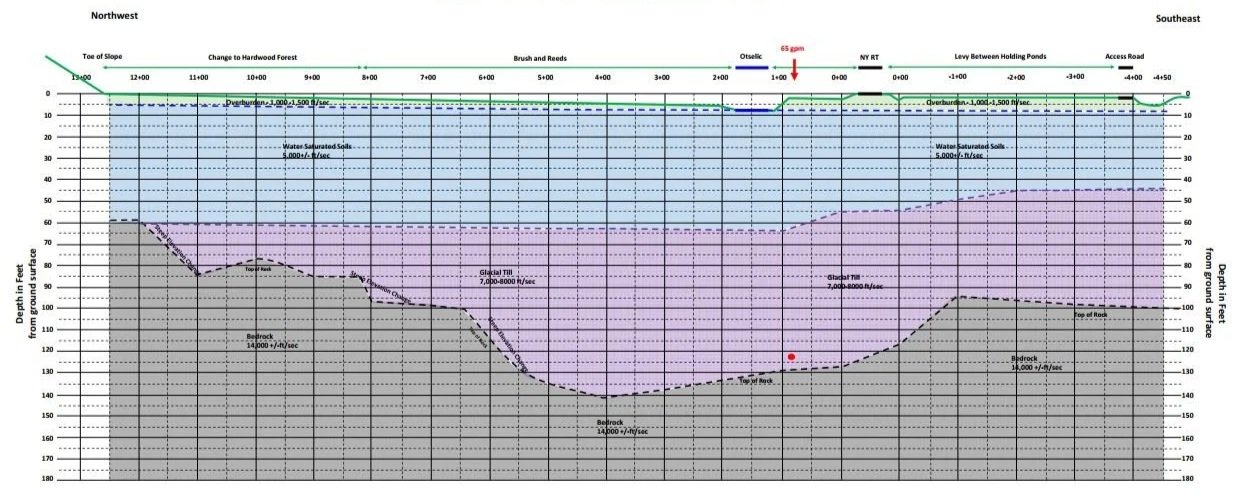
Bedrock Anomaly Detection: Identified a significant "U"-shaped depression in the bedrock surface along Transect 2, measuring 700 feet wide and 35–40 feet deep beneath the glacial till.
Paleochannel Identification: Determined that the "U"-shaped depression likely represented a pre-glacial riverbed, a geologic feature often characterized by the coarse gravel deposits required for high-volume water extraction.
Strategic Well Siting: Provided engineers with the exact coordinates of the bedrock depressions, allowing them to move the well location from low-yield strata to a high-capacity aquifer zone.
Optimized Operations: The resulting data-driven well placement optimized water flow rates, successfully meeting the facility's demand and eliminating the need for costly, speculative exploratory drilling.